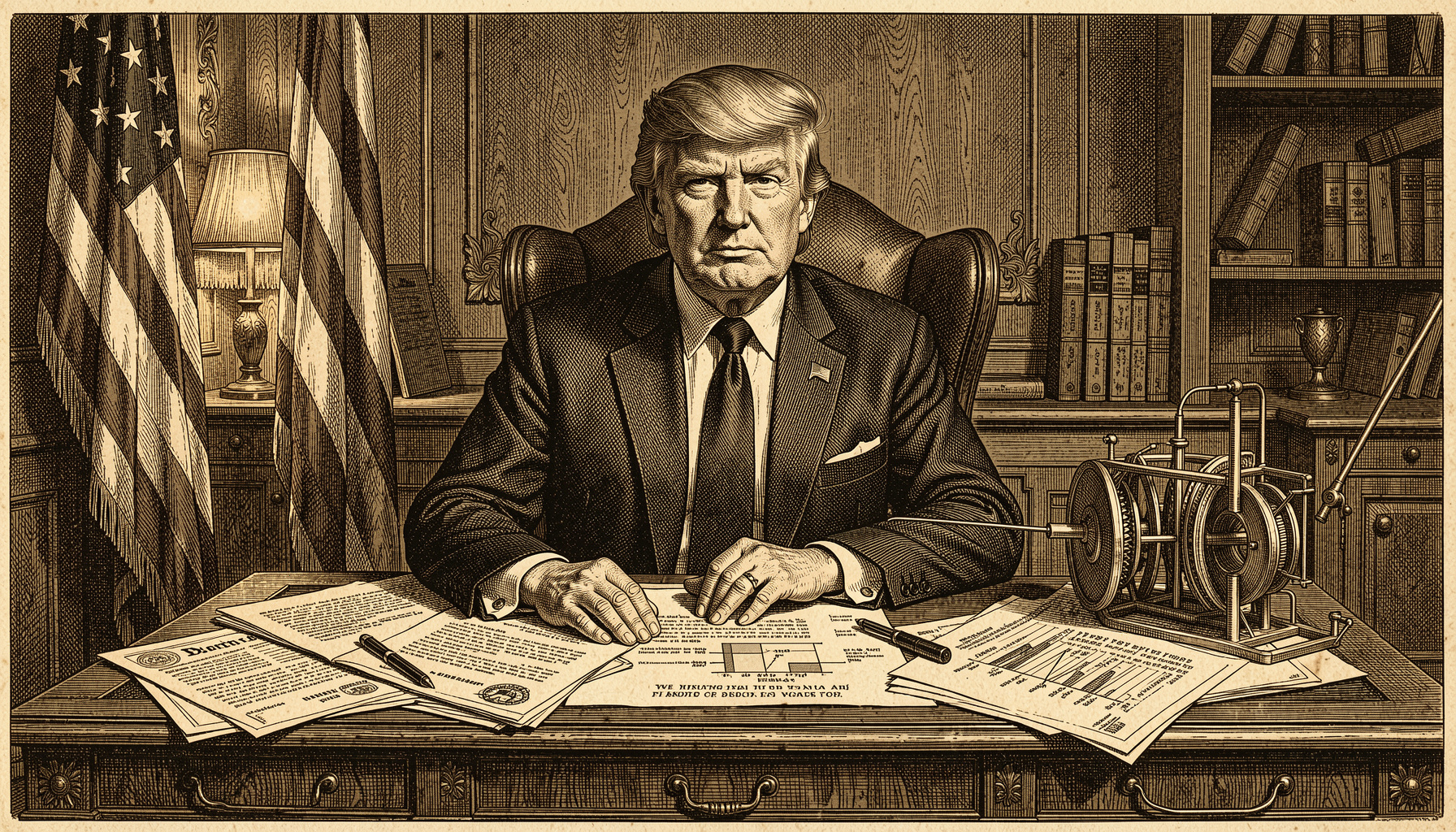

There is a principle I advanced in my Wealth of Nations, and which I think the present circumstances in these United States illustrate with a clarity that no lecture of mine could improve upon: that those who trade in the same commodity have a natural interest in raising its price, and that when such persons also hold the power to write the rules of the market, the publick may expect arrangements of a peculiar convenience. The arrangement now before us concerns a thing called nuclear fusion, and it is, by any dispassionate account, a matter worth attending to.
Trump Media & Technology Group, a concern whose principal asset is a social platform valued by the market at a sum that would have confounded any merchant of my acquaintance, is reported to be advancing toward a merger with a company engaged in the pursuit of fusion energy. Fusion, for those unacquainted with the natural philosophy of the age, is the process by which light atomic nuclei are joined under conditions of extreme heat, releasing energy in quantities that its advocates describe as essentially boundless. It has been, for some decades, a promising art; the jest among men of science being that its commercial realisation remains perpetually thirty years distant. Whether the present decade shall prove different, I am not qualified to say.
What I am qualified to observe is the sequence of events. The administration of the sovereign whose name the media company bears has, in recent weeks, moved to extend new regulatory structures and expressions of executive favour to the fusion industry at large. The Department of Energy has signalled support. White House pronouncements have followed. And the media company connected by name, association, and shared commercial destiny to that same sovereign is positioned, by the merger in question, to hold an equity interest in precisely the industry so favoured.
I wrote in my Theory of Moral Sentiments that we are rarely so good a judge of our own interests as we suppose, and rarely so disinterested as we declare. The impartial spectator — that faculty of conscience I described as a third party within the breast — would, I venture, find the present arrangement a rather strenuous test of its powers of detachment.
The fusion company involved has not yet produced commercial energy. The media company involved has not yet produced a profit of the kind a ledger-keeper would recognise without qualification. Between them, they have attracted a valuation and a policy environment that a productive manufactory of wool or iron might contemplate with some bewilderment. What the nation has produced, in the meanwhile, is a case study in the manner by which the grant of publick favour flows, and in whose direction it most reliably travels. This is not, I should note, a circumstance peculiar to republics; I observed its like in the trading companies and parliamentary interest-holders of my own century. It is, rather, a persistent feature of political economy that rewards the attention of any sovereign willing to look upon it steadily.