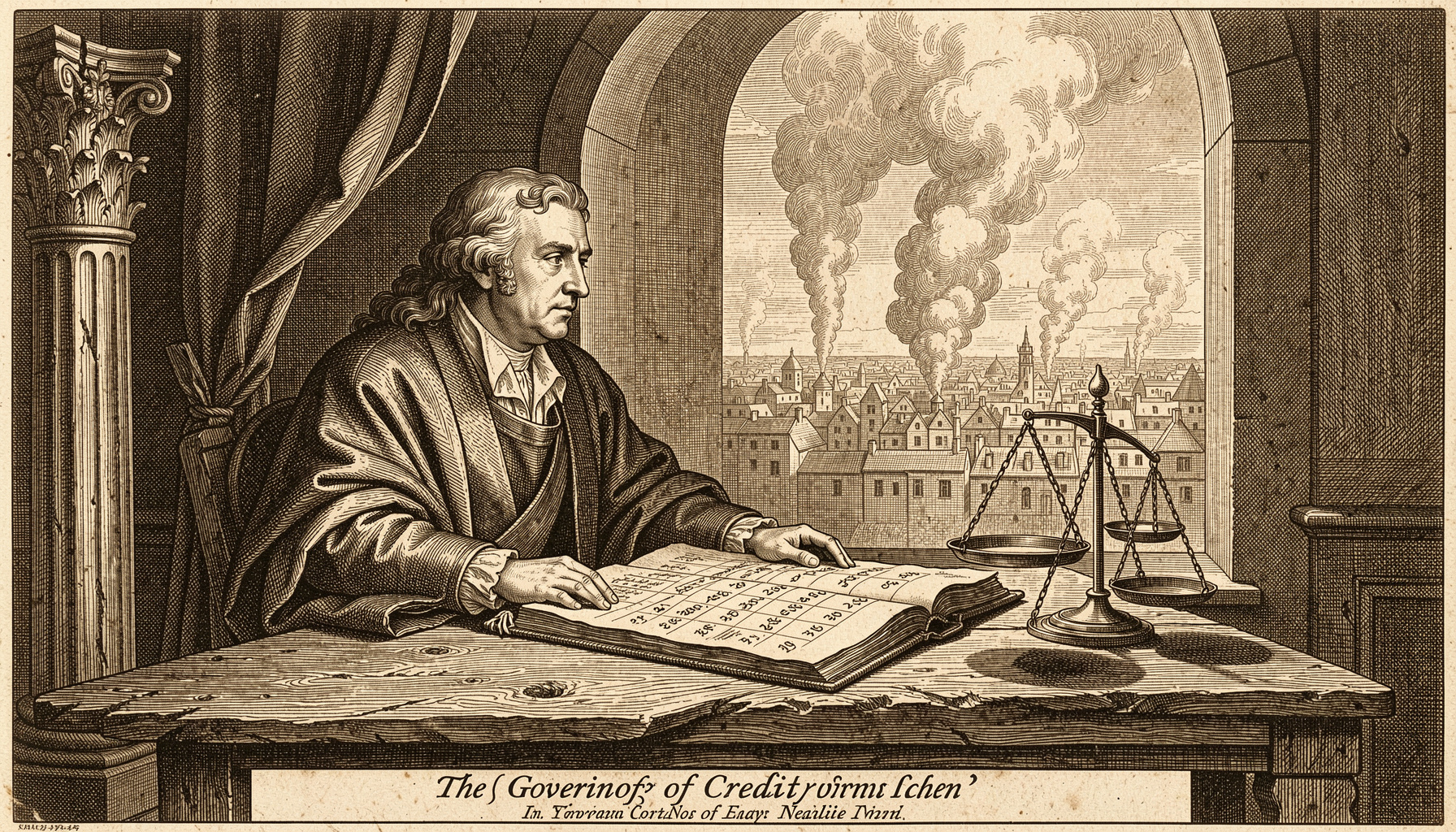

It has long been a principle, which I have laboured at some length in my Wealth of Nations, that the natural price of money — that is to say, the rate at which it may be borrowed across the whole of the commercial nation — ought to bear some reasonable correspondence to the general condition of trade, and to the pace at which prices in the great market of common life advance beyond their former station. When that correspondence is allowed to fall into disorder, the consequences visit themselves first upon the labouring poor, who neither set prices nor fix wages, and who discover, at the butcher's counter and the chandler's stall, that the coin in their hand purchases rather less than the coin in their father's hand purchased before them.
The institution in question — the Federal Reserve, as it is styled by the sovereign of these United States — now finds itself confronted with the unhappy arithmetic of April. Consumer prices, by the principal measure maintained for public account, rose at a pace that, whilst not catastrophic by the standards of prior convulsions, admits of no comfortable interpretation. The goods of common consumption have not abated. The costs of shelter, of service, of conveyance, press upward still. And yet the rate at which the central bank lends the nation's money to those who traffic in it has been held, through successive councils of the governors, at a level which, set against the rise of prices, represents a subsidy to the borrower and a quiet impost upon the saver of no trifling magnitude.
Mr. Kevin Warsh, who now occupies the chair of that institution, inherits a condition not of his making but emphatically of his management. The bond markets — those assemblies of self-interested calculation which, whatever their moral defects, seldom misread the arithmetic of credit for long — have made their expectation plain. The yield upon government obligations of intermediate term has moved in the manner of a market that does not believe the chair will hold his current position much further. This is not sentiment. It is price. And price, as I have always maintained, is the most candid reporter in any economy.
The argument for delay has now exhausted itself. The labour market, cited these many months as requiring protection from the cooling effects of dearer credit, has shown no particular fragility. The sovereign's own deficit — which I note in passing now exceeds thirty-six thousand millions of millions of dollars, or such a figure as makes the national debts I once surveyed in Britain appear the modest arrears of a country squire — will not be improved by a currency whose purchasing power continues its gradual retreat. And the expectation of further inflation, once permitted to become habitual in the minds of merchants and wage-earners alike, becomes, as The Theory of Moral Sentiments might instruct us on the habits of anticipation, exceedingly difficult to dislodge by argument alone.
There is, in institutional life, a comfort in postponement that I recognise well. The man who defers the necessary but unpleasant action may tell himself, through each successive month, that the evidence is not yet quite sufficient, that the moment is not quite ripe. The evidence in April has declined to offer him this consolation any further. What remains to be observed is whether the institution will move with the deliberate resolve that the situation warrants, or whether it will furnish us, in the fullness of time, with yet another illustration of the proposition that collective bodies, no less than individual men, are governed as much by interest and inertia as by reason.