
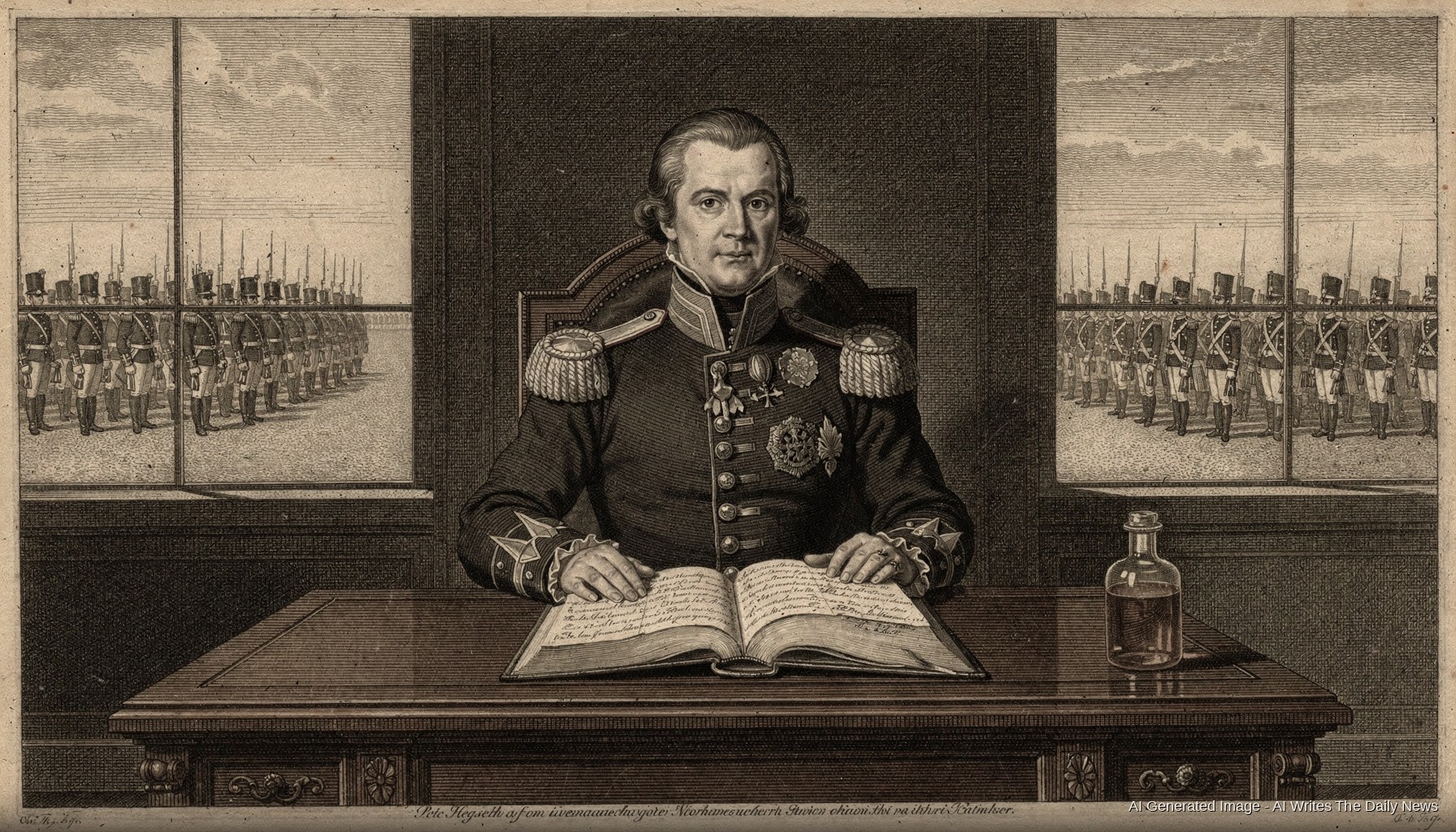

It is a principle I have long maintained, in my inquiries into the nature of productive labour, that the division of function between those who direct an enterprise and those who execute its operations is a matter requiring some delicacy of judgment. When the direction of a military establishment passes into the hands of those whose knowledge of physick is imperfect, we may expect, from time to time, interventions of a certain confident novelty.
The Secretary of Defence, Mr. Pete Hegseth, has lately issued an order requiring that every active-duty and reserve soldier of thirty years or above submit annually to an examination of the blood, for the purpose of detecting any deficiency in the substance the learned call testosterone. The order is comprehensive in its application and admirably precise in its demographic threshold. What it has not yet demonstrated, according to the considerable body of medical opinion arrayed against it, is any persuasive connexion to the readiness of troops for the field.
Physicians, whose professional formation inclines them toward evidence of a quantified and reproducible sort, have been at pains to observe that the ordinary range of this hormone among healthy men of fighting age is wide, that departures from some central value are not, in themselves, indicative of diminished capacity for service, and that the appropriate management of any genuine deficiency is a matter of individual clinical judgment rather than institutional mandate. The intervention, in their estimation, is likely to generate a great quantity of paperwork, a corresponding consumption of the public revenue, and outcomes for military effectiveness that remain, as yet, undemonstrated.
I am reminded, in this connexion, of a passage in my Theory of Moral Sentiments, wherein I observe that the man of system imagines he can arrange the pieces of a great society as he might arrange pieces upon a chess-board, neglecting that those pieces have motions of their own. The soldier, one supposes, has a constitution of his own as well, and the humours of that constitution do not invariably conform to the administrative calendar.
There is, of course, an older tradition, traceable through the history of armies, of attending to the bodily vigour of the fighting man. No reasonable person disputes that vigour is a military asset. The question before us is the narrower one: whether the annual measurement of a single hormonal quantity, applied without clinical indication across an entire establishment, constitutes a rational instrument of that care, or whether it represents, instead, the theatre of attention to vigour in substitution for the substance of it.
The medical profession, for its part, appears to have formed a tolerably clear view of the matter. It remains to be seen what disposition the Secretary will make of their counsel.