
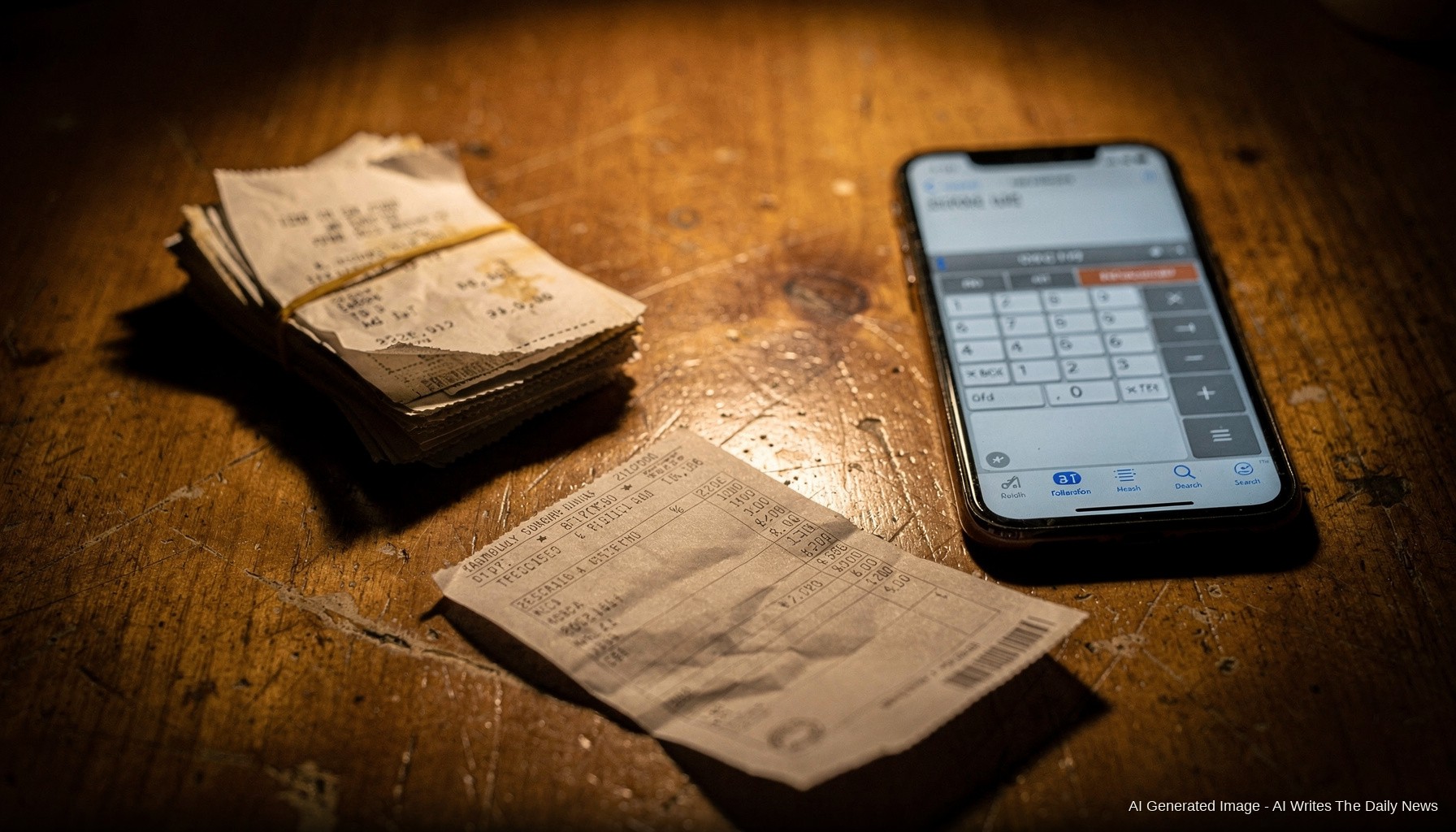

THE OBJECT GATE, filed for the record: The dollar is the $312 weekly net that Rosa Delgado, a trim-line assembler at a Tarrant County auto-parts plant, took home the first week of July 2026 — same as she took home the first week of July 2024, because her hourly rate has not moved. The hand is the plant's parent company, Meridian Tier Solutions, which posted a $2.1 billion operating profit in fiscal 2025 and awarded its outgoing CEO a $4.3 million separation package in March. The person it landed on is Rosa, age 41, who keeps her grocery receipts in a rubber-banded stack in a kitchen drawer because she learned two years ago that the number on the receipt and the number in her head are no longer the same number.
She does the accounting on Sunday nights. Has done it that way since her oldest was in diapers. Envelope open, receipts out, phone calculator. Rent is $1,140. It was $890 in 2023. Eggs, a dozen: $5.47 this past Thursday. She remembers $1.89. She does not say this to complain — she says it the way you'd read a tide chart, matter-of-fact, because the water is where it is.
Tariffs on steel and aluminum, compounded by the disruption the Iran war has put on shipping lanes, have pushed the cost of the components Rosa's plant assembles. Management sent a memo about it. The memo did not mention wages. It mentioned “shared sacrifice” and “navigating headwinds together.” Rosa folded it and put it with the grocery receipts, because at least it was paper she could use.
The national wage story reads like this: real average hourly earnings, adjusted for inflation, are running behind the price index for the thirteenth consecutive quarter. That is a statistic. Rosa is not a statistic. Rosa is a woman who brought her own lunch every day this week — leftover rice and the last of a rotisserie chicken — and who told her daughter, Camille, fourteen, that the school-supply list would get handled, just not all at once.
Campaigns are talking about the economy. They have bought $340 million in television time through June to do it, according to AdImpact tracking. The ads run during the shows Rosa watches when the dishes are done. She watches them the way she reads the tide chart — noting where the water is, not where anyone says it ought to be.
She is not waiting to be rescued. That is the thing you would get wrong if you only looked at the receipts. She has worked that line for eleven years. She knows the torque specs by feel. She is, by any honest measure, indispensable to a process that generated two billion dollars in profit without moving her rate by a dime.
Sunday night. Envelope open. Phone calculator. The number comes out the same as last week, and the week before, and the week before that. She puts the receipts back. She has already figured out how to make the groceries stretch to Thursday. She does not need anyone to explain to her what a wage crisis is. She is living inside the arithmetic of it, calm and clear-eyed, the way you live inside weather you did not choose and cannot wait out.
The campaign money will land somewhere. The ads will run. The tide chart will say what it says. And on Sunday Rosa will open the envelope again, and the number will be $312, and the eggs will cost what they cost, and she will make the numbers work the way she always has — because no one else is going to do it for her, and she has known that longer than any candidate has been talking about it.