

There is a passage in my Wealth of Nations wherein I observe that the monopoly of the colony trade is, in its very nature, an act of violence against the consuming public, yet that the public, in time, ceases to perceive it as violence at all, and begins instead to reckon it among the ordinary charges of commerce. I confess that I had not foreseen so literal a demonstration of this principle as the one now unfolding at the mouth of the Persian Gulf.
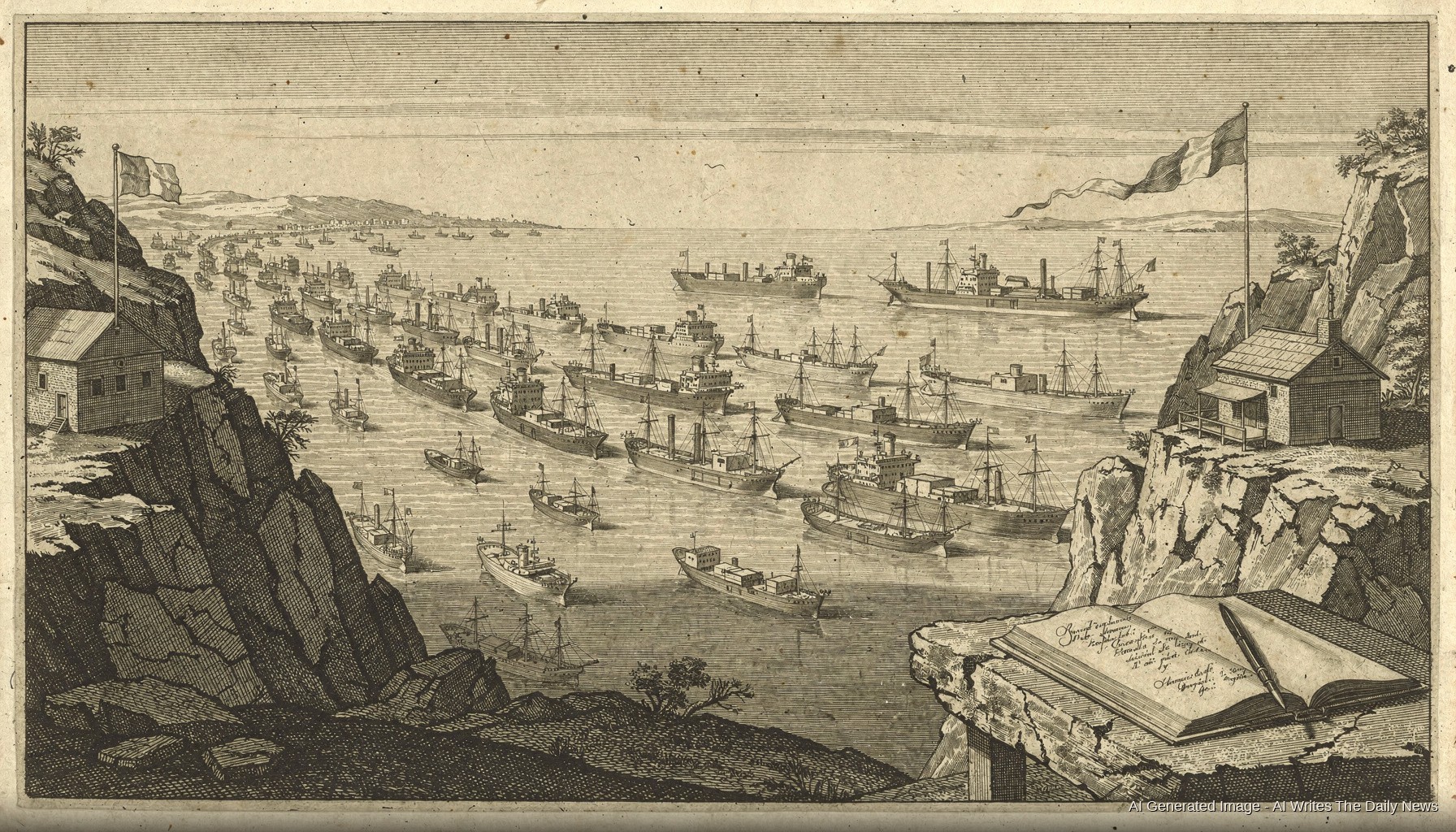
The Strait of Hormuz, through which some considerable portion of the world’s petroleum and liquefied natural gas finds its passage from the producing nations of the Gulf to the consuming nations of Europe, Asia, and beyond, is now the subject of a negotiation whose outcome the leading maritime powers of Europe have decided, with notable equanimity, to accept in advance. Ships, it is anticipated, will pay a fee to the Islamic Republic of Iran and to the Sultanate of Oman for the privilege of transiting waters that international convention has long held to be open to innocent passage by all nations without toll or impost.
The logic offered in support of this acquiescence is the logic of exhaustion rather than of principle. A war has been prosecuted. Its costs have been reckoned. And the European chancelleries, surveying what remains, have arrived at the conclusion that a recurring charge upon the carrying trade is preferable to the continuation or resumption of hostilities. This is, in its way, a perfectly rational calculation, of the sort that merchants have made at every tollgate and every river crossing since commerce first extended itself beyond the village green.
What is remarkable is not the calculation but the candour with which it is now made public. Sovereignty over the sea-lanes, which successive generations of statesmen regarded as the very sinew of naval and commercial power, is here yielded not in a treaty, not in a formal instrument, but in the gradual revision of expectation — the quiet migration of a thing once called intolerable into the column of ordinary operating costs.
I have written, in the Theory of Moral Sentiments, of the human capacity to accommodate ourselves to circumstances we should once have thought unendurable. The merchant who pays the toll at Hormuz will not long remember a time when no toll was asked. His factor will enter the charge against the cargo. His customer will find the price of fuel somewhat elevated. And the sovereign who once declared the freedom of the seas an interest worth defending will have discovered, in the interval, that the interest was not, in the final reckoning, worth quite so much as was supposed.
The precise schedule of fees has not yet been published. It will be, in time. Commerce is patient, and has long experience of tollgates.