
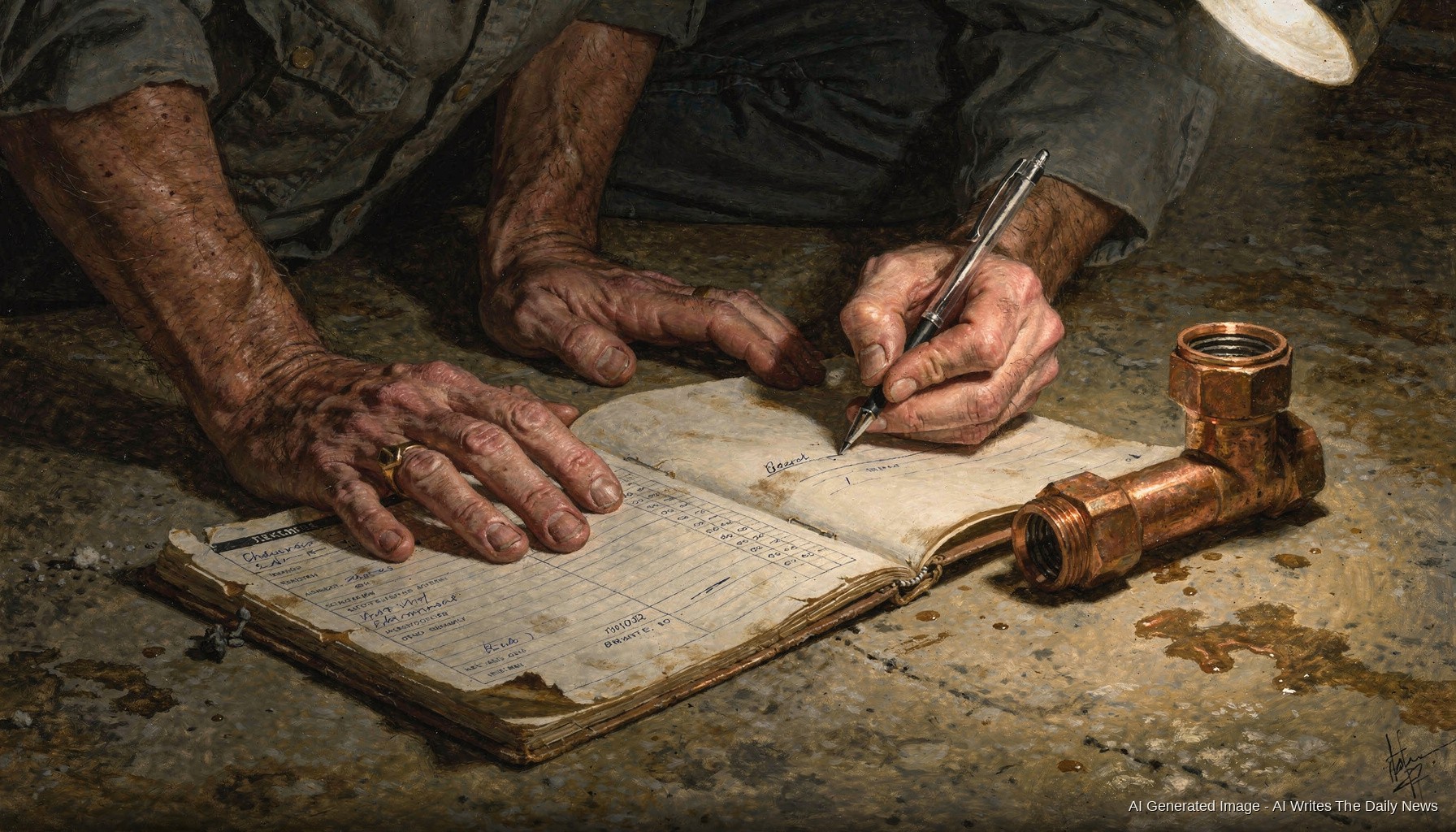

Ray Kowalski is not a composite. He is a plumber in Youngstown, Ohio, forty-three years old, who spent two years at a vocational program that his own high school tried to shut down the year after he enrolled. He charges $250 for a service call. His customers complain about it. His customers also cannot do what he does.
Start there. Start with the $250, because that is where the dollar enters the story, and the story has been running a long time before it gets to Ray.
Somewhere in the late 1980s, a decision got made — not in one room, not by one hand, but in school boards and state legislatures and university marketing offices across the country — that a four-year degree was the only exit ramp off the highway of being poor. Shop class was dismantled. Vocational programs were defunded or quietly allowed to starve. Counselors were told, and then told their students, that a kid who wanted to learn electrical work or plumbing or HVAC was a kid who had given up.
This was dressed up as opportunity. It was dressed up as equity. What it was, in practice, was a reallocation — of prestige, of public funding, of cultural legitimacy — away from the people who build and fix things and toward the people who administer the people who build and fix things. The money followed. The dignity did not.
The downstream cost is not abstract. There are roughly half a million unfilled skilled-trades positions in this country right now, and the ones that are filled are filled by men and women who are, on average, getting older every year and are not being replaced fast enough. The pipeline was not broken by the market. The pipeline was broken by people who controlled what the market valued, and they controlled it through credential requirements, through school funding formulas, through the steady cultural message that a young person with a torque wrench in their hand was somehow less than a young person with a laptop and a student loan.
Ray Kowalski will tell you he is not bitter. He will tell you this while he is replacing the fitting your home inspector missed, while his knees are on your basement floor. He went into debt for his tools, not for a degree. He built his own business. He is booked six weeks out.
And still, somewhere in the room, someone says $250 is a lot for a plumber.
That is the sentence that carries the whole policy in it. That is thirty years of contempt compressed into a shrug. The person who says it could not locate the shutoff valve if the house were filling with water. The person who says it took out $60,000 in loans to study communications and is still, at thirty-eight, not sure what they are communicating or to whom.
Ray does not need your sympathy. He needs you to understand that what happened to the trades was not drift, was not the natural order of markets sorting themselves out. It was chosen. It was funded. It was taught, in the sense that every generation is taught what is worth respecting and what is not.
He finishes the job. He writes the invoice. He hands it over without apology, because there is nothing to apologize for — he showed up, he fixed it, and nobody else was coming.
Two hundred and fifty dollars. His name on the receipt. The water running clean.