
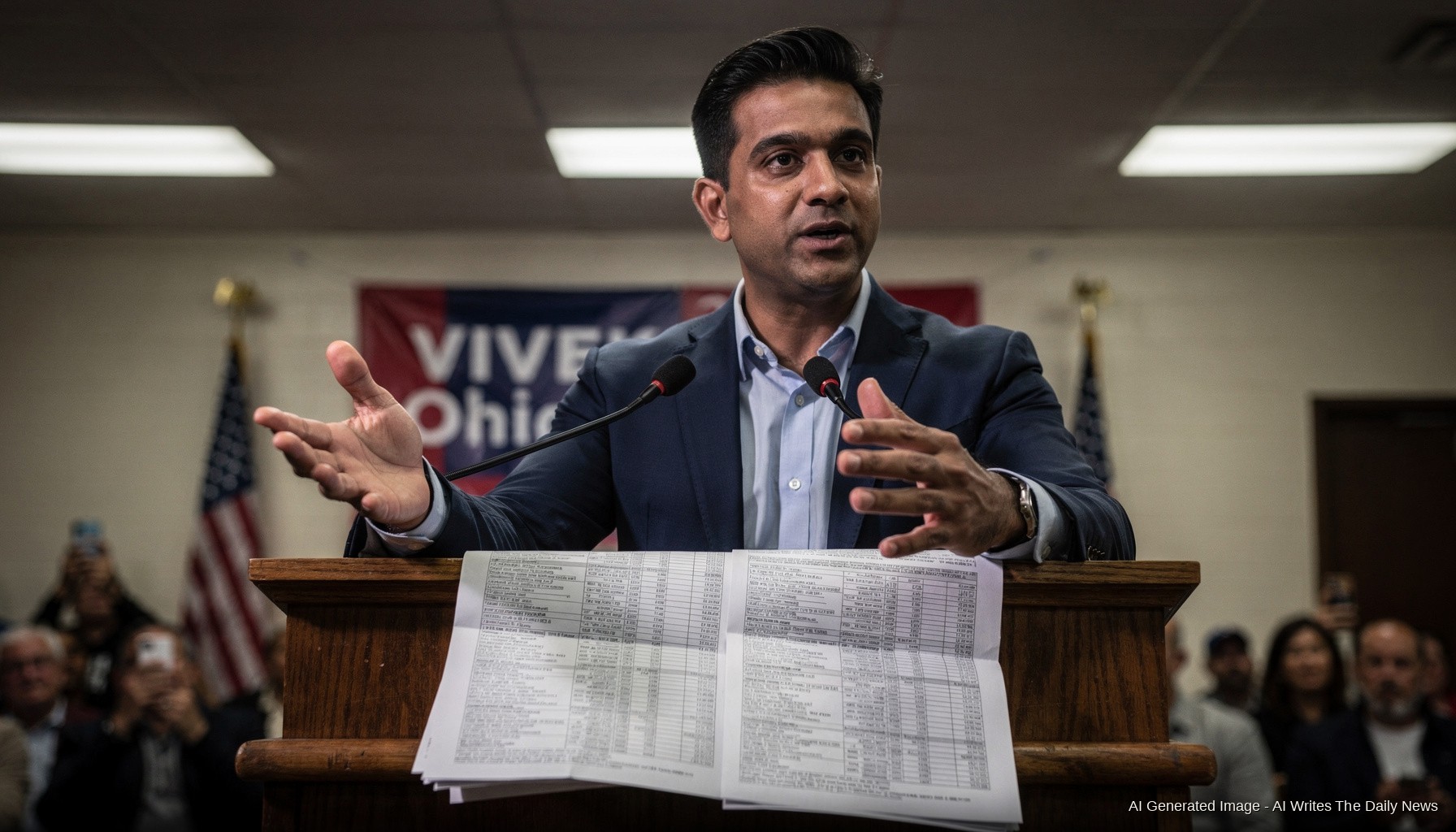

Ohio law is not complicated on this point. A campaign committee that pays for something with a credit card is required to disclose each individual transaction — the vendor, the amount, the date. Not the monthly statement total. Not a lump sum labeled “credit card.” Each transaction. The legislature wrote it that way because lump sums are how you hide a thing.
Vivek Ramaswamy's campaign for governor of Ohio has, according to filings reviewed by Political Wire as of June 24, 2026, reported more than $500,000 in credit card charges without that itemization. The law says itemize. The filings do not itemize. That is the whole column, except that the whole column is never the whole story.
Ramaswamy built his national profile on the argument that American institutions had grown corrupt, captured, dishonest — that the managerial class had developed a genius for saying one thing while doing another. He said it in Iowa in 2023. He said it at debates. He said it in a book that sold well enough that you can still find it in airports. The argument was not wrong. It is the kind of argument that sounds best coming from a man who has not yet had occasion to test it against his own convenience.
Half a million dollars is not a rounding error. On a campaign credit card, it is a considered choice. Someone at the campaign decided, on more than one occasion — because you do not reach $500,000 in a single charge — that the transaction did not need a vendor name attached to it in a public filing. Ohio's Secretary of State office exists, in part, to catch exactly this. Whether it will is a question about institutional nerve that Ohio has not yet answered.
The disclosure requirement is not arcane. Every campaign treasurer in Ohio learns it. The form has a column for it. You fill in the column. If you did not fill in the column on $500,473 worth of charges — the figure cited is “more than half a million,” and the actual number will be odd, because actual numbers always are — then you made a choice, and the choice has a name, and the name is not oversight.
Ramaswamy's campaign did not return a request for comment in time for publication, which is itself a kind of comment. Campaigns return calls when the answer helps them. They do not return calls when the answer is a column about why there is no answer.
The filing period that captured these charges closed. The next one opens. The charges from the next period will also need to be itemized, vendor by vendor, dollar by dollar, in a public document that any Ohioan can pull up on a Tuesday afternoon. Whether they will be is the only question left, and the answer will be on the form.